Last year the BBC ran a TV drama series Life in Squares. It followed, in three episodes, the entangled lives of the Bloomsbury Group - the Bells, the Woolfs, Duncan Grant, Maynard Keynes, and Roger Fry et al. Dorothy Parker - not a member herself, obviously, though she might have gone down well - quipped that they "talked in circles, loved in triangles, lived in squares".
The TV series sparked our own blog series - Played on Squares - in which we tried to answer the straightforward question (one that nobody in the sprawling corpus of Bloomsbury archival analysis, informed commentary, and learned exegesis, had thought to ask), viz: did they play chess?
The answer, we discovered, was an unavoidable "yes". The Bloomsberries admitted to chess in their diaries, and their memoirs; they documented and commented on their obsessive playing of, and sometime brazen cheating at (Roger Fry was exposed as the culprit), our favourite game; one of them (Fry again) used it as a teaching aid in his lessons on aesthetics; two of them were portrayed in oils at the board (and another was sketched in situ), and several of them were photographed in flagrante. One - Leonard Woolf - almost joined a chess club, and another actually did - although this is stretching a point as she was only a Bloomsbury-sibling and not a Bloomsbury-proper. However, as she also played in tournaments and even turned up in the BCM - snapped playing in a simul. against Vera Menchik (result unknown) - she (Marjorie Strachey) was the star turn of our chess-in-Bloomsbury series.
Not that you would have found any of this on the TV. Shocking.
Just after the series closed, our good friend Richard James was kind enough to point out that it was unfinished: there was in fact a Bloomsberry with a well-documented chess interest who we had missed. Also shocking. So, before leaving it any longer, we had better repair this omission and report the chess doings of...
Friday, 30 September 2016
Wednesday, 28 September 2016
Heads up
No official announcement yet, but here's an interesting addition to the FIDE Calendar 2017.
Also see, FIDE 2016 General Assembly decisions.
Now the thing about Iran is, it does have rules and regulations that apply to women, ones that do not apply in most other countries, and this is, shall we say, potentially a matter for concern.
Without any official announcement, let alone one touching on the matters this raises, it's hard to say anything definitive, but I sent an email to the FIDE office to see what they could tell me.
They replied, very promptly, as they generally do.
You'll perhaps have noticed that while Polina hasn't actually said yes, nor has she said no, and her answer is more along the lines of yes than no. However, I subsequently received an email clarifying that women attending the championship will, indeed, be expected to wear the headscarf whether they like it or not.
Now matters relating to the headscarf are sensitive, as are matters relating to Islam, and for this reason commentors are asked to be thoughtful in what they say on the subject*. But it does seem to me that women should not be obliged to wear the headscarf as a condition of competing in, reporting on or simply attending a chess tournament, and if it is a condition of the host country that this occurs, then it probably shouldn't be the host country.
To say so isn't to lecture another country on what laws or customs it should have. It's to say that the laws and customs of the chess world should not be such as to discriminate against women. FIDE shouldn't be doing this: if and when there's a row, they will only have themselves to blame.
[* additionally - anonymous comments will not be permitted, and please do not make this all about a certain English grandmaster.]
[thanks to Chris Rice]
[this piece revised after publication in order to incorporate the final email]
Also see, FIDE 2016 General Assembly decisions.
Now the thing about Iran is, it does have rules and regulations that apply to women, ones that do not apply in most other countries, and this is, shall we say, potentially a matter for concern.
Without any official announcement, let alone one touching on the matters this raises, it's hard to say anything definitive, but I sent an email to the FIDE office to see what they could tell me.
To: office@fide.com
27 September 2016 at 12:07
Dear FIDE
Sorry to bother you. I am a chess writer and a member of the English Chess Federation.
I read on your website that the 2017 Women's World Championship has been awarded to Iran (General Assembly decision GA-2016/31). I am writing to enquire whether women competing, reporting, spectating or attending in any other capacity will be required by their hosts, to wear clothing, for instance the headscarf, that they would not be obliged to wear in their home countries.
Yours sincerely
Justin Horton
Huesca province Spain
They replied, very promptly, as they generally do.
From: FIDE Secretariat office@fide.com
To: Justin Horton
cc: Nigel Freeman
27 September 2016 at 12:14
Dear Justin
From my personal experience, all foreign women are obliged to wear headscarf in all public places in Iran.
best regards
Polina Tsedenova
FIDE Secretariat
You'll perhaps have noticed that while Polina hasn't actually said yes, nor has she said no, and her answer is more along the lines of yes than no. However, I subsequently received an email clarifying that women attending the championship will, indeed, be expected to wear the headscarf whether they like it or not.
From: Nastja Karlovich
To: Justin Horton
cc: Nigel Freeman, FIDE Secretariat
date: 27 September 2016 at 13:53
Dear Mr. Horton!
all competitors will be obliged to respect the laws of the country including the dress requirements.
You can check the UK foreign office for more information:
Best regards, Anastasiya Karlovich
FIDE Press Officer
Now matters relating to the headscarf are sensitive, as are matters relating to Islam, and for this reason commentors are asked to be thoughtful in what they say on the subject*. But it does seem to me that women should not be obliged to wear the headscarf as a condition of competing in, reporting on or simply attending a chess tournament, and if it is a condition of the host country that this occurs, then it probably shouldn't be the host country.
To say so isn't to lecture another country on what laws or customs it should have. It's to say that the laws and customs of the chess world should not be such as to discriminate against women. FIDE shouldn't be doing this: if and when there's a row, they will only have themselves to blame.
[* additionally - anonymous comments will not be permitted, and please do not make this all about a certain English grandmaster.]
[thanks to Chris Rice]
[this piece revised after publication in order to incorporate the final email]
Friday, 23 September 2016
Thursday, 22 September 2016
Basmantics
What's this, do you think?
It's this, is what it is.
Surely not, the reader surely says.
And yet
it surely is.
It's this, is what it is.
Surely not, the reader surely says.
And yet
it surely is.
Monday, 19 September 2016
Holy tax evasion, Basman
Chessbase, 2008
I'd intended to write a piece last weekend about a crochety old English chess master who gets into trouble when he doesn't think the rules apply to him. However, being, in truth, a little more sympathetic to Nigel over that particular issue than I normally am, we'll leave that aside for the moment. Instead, let's talk about Mike Basman.
Why so? Because the popular British IM has got himself into trouble. How so? Take your pick. It's either
- because over perhaps as long as twenty years, he couldn't be arsed to comply with his legal obligations with regards to tax; or
- because he is being persecuted by Her Majesty's Revenue and Customs
The exact details of the saga which have led to Basman's current predicament are not yet entirely clear, the reason for this being that Mike Basman has chosen not to make them entirely clear (which we will get on to, below). Nevertheless the basic outline seems straightforward enough - it appears that
- the UK Chess Challenge, the competition that Mike Basman has organised since it began in 1996, has failed to charge VAT on entry fees for its competitions, as it was legally obliged to do;
- this having come to HMRC's attention, they have presented Basman with a bill representing an estimate of the revenue lost to them over a ten year period, which is in the non-trivial amount of £300,000; and
- as Basman cannot pay this bill, he was made bankrupt on 8 August 2016, thus threatening the future of his competition (leaving aside alone any consequences for himself).
I have a view on this, which is that Mike Basman is a fool, a fantasist and a tax evader.
Caption competition waiting to happen
Friday, 16 September 2016
A French Connection
![]() |
| Photo from the Condé Museum in Chantilly. Taken 1858/9. |
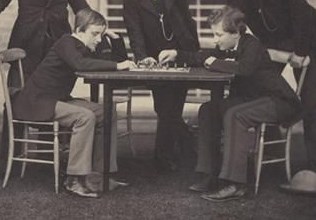
Sitting on the left playing chess is Prince Louis of Condé (1845-1866), who was living in Orleans House, in Richmond on Thames, at the time. He developed TB and died in Australia. He was a paternal grandson of King Louis Philippe via Duke Henri of Aumâle.
His opponent is Prince Augustus of Saxe-Coburg and Gotha
(1845-1907), whose father was a cousin of Queen Victoria and Prince Albert from
the Catholic branch of the family. On the maternal side he was a grandson of
King Louis Philippe via Princess Clémentine of Orléans.
Prince Pierre, Duke of Penthièvre (1845-1919), a grandson of
King Louis Philippe via Prince François
of Joinville. Related to the Portuguese royal family and the emperors of
Brazil on his mother’s side. “Prince Pierre had a happy childhood as a refugee
in England with most of the other members of the House of Orléans, despite the
uncertainty of life in exile.” This seems to have been at Claremont, near Esher in Surrey
Prince Philipp of Saxe-Coburg and Gotha (1844-1921), the older brother of Prince Ludwig August (see above). Married his cousin, Princess Louise of the Belgians, who was reported to have played chess against Queen Victoria.
Prince Ferdinand, Duke of Alençon (1844-1910), another grandson of King Louis Philippe via
Duke Louis of Nemours.
Prince Gaston Count of Eu (1842-1922), the older brother of
Prince Ferdinand (see above). His family fled to England after the overthrow of
the monarchy in 1848.
So in this picture we have six French princes, all grandsons
of King Louis Philippe of France, who reigned between the July Revolution of
1830 and the February Revolution of 1848. He fled the country under the name of
“Mr Smith” [no relation - MS] and sought exile in England, settling at Claremont. It
seems likely that this photograph was taken at about the time of the funeral of
their aunt Hélène, the widow of the King’s eldest son Ferdinand. She died on 18
May 1858 at her home in Richmond, Camborne House, Petersham Road, close to
Richmond Bridge. It was later renamed Northumberland House and demolished in
1969. The funeral took place on Saturday 22 May, the cortège travelling from
Richmond to the chapel of St Charles Borromeo in Weybridge. All the Orléans
princes were in attendance. At the time four of the princes were living in the
area: Prince Louis was living at Orleans House while the Princes Gaston,
Ferdinand and Pierre were at Claremont. The Princes Philipp and Augustus were
living on the continent, possibly in either Austria or Spain.
So perhaps the most likely location for the photograph is
Camborne/Northumberland House.
[With thanks again to Richard James. To follow a French music and chess connection, and notes on many more musical chessers besides, go to his series, starting somewhere else, here.]
Lost in History
[With thanks again to Richard James. To follow a French music and chess connection, and notes on many more musical chessers besides, go to his series, starting somewhere else, here.]
Lost in History
Friday, 9 September 2016
Chess in Art: RA Afterthought
[This post by Martin Smith]
We were talking a few of weeks ago about Chess in Art at this years Royal Academy Summer Exhibition. Well, there wasn't any. Which was a bit disappointing, and makes you wonder whether today's aspiring artists are really trying hard enough. But still, it is probably right that the RA's selection committee shouldn't let in any more arty chess sets - stunning though they might be - especially when modelled on the buildings of the capital: ancient, modern, and ancient-looking-but-built-just-now, stunning though they all may be as well.
You'll remember we saw one such chess set last year...
...and another just five years before that:
So, whatever the seductive materials employed, or the fine craftsmanship at work, enough is enough - especially as complete chess addicts don't have to go the RA to see London skylines. We have them in our own backyard:
Nonetheless, recent developments in my neck of the woods give cause to revisit all this, and look again at the aesthetics of chess-in-architecture.
We were talking a few of weeks ago about Chess in Art at this years Royal Academy Summer Exhibition. Well, there wasn't any. Which was a bit disappointing, and makes you wonder whether today's aspiring artists are really trying hard enough. But still, it is probably right that the RA's selection committee shouldn't let in any more arty chess sets - stunning though they might be - especially when modelled on the buildings of the capital: ancient, modern, and ancient-looking-but-built-just-now, stunning though they all may be as well.
You'll remember we saw one such chess set last year...
| Franklin's Morals of Chess (2015) By Karl Singporewela |
![]() |
| Style Wars: Modernists versus Traditionalists (2010) By Mobile Studio |
Nonetheless, recent developments in my neck of the woods give cause to revisit all this, and look again at the aesthetics of chess-in-architecture.
Tuesday, 6 September 2016
How many more times?
Leontxo García has news for us!
Apparently chess has about six hundred million followers around the world.
It doesn't, of course.
This isn't the first time Leontxo's facts and figures have been at variance with reality.
Come to that, it's not the first time Leontxo's put about this particular figure.
Last time he did, and was advised by the present writer that the facts were otherwise, he promised to do some research.
Busy man, Leonxto García. Very busy man.
[Oh, and YouGov is not an American company.]
Apparently chess has about six hundred million followers around the world.
It doesn't, of course.
This isn't the first time Leontxo's facts and figures have been at variance with reality.
Come to that, it's not the first time Leontxo's put about this particular figure.
Last time he did, and was advised by the present writer that the facts were otherwise, he promised to do some research.
Busy man, Leonxto García. Very busy man.
[Oh, and YouGov is not an American company.]
Friday, 2 September 2016
Chess in Art: Miss Tanning's Appendix
[This post by Martin Smith]
In this appendix to last week's post you are requested to take another look at the ensemble photograph of Germaine Richier's L'Echiquier (Grand) of 1959 (currently on display at Tate Modern), and observe how the Queen (second on the right) is stealing a sideways glance up at the wall. She is flapping her arms to signal her excitement. The Knight takes evasive action.
She must have noticed something.
In this appendix to last week's post you are requested to take another look at the ensemble photograph of Germaine Richier's L'Echiquier (Grand) of 1959 (currently on display at Tate Modern), and observe how the Queen (second on the right) is stealing a sideways glance up at the wall. She is flapping her arms to signal her excitement. The Knight takes evasive action.
She must have noticed something.
Friday, 26 August 2016
Chess in Art: Richier Revisited
[This post by Martin Smith]
This post comes a little late to advise you on any chess-art at this year's Royal Academy Summer Exhibition, as it is now closed. Not to worry. There wasn't any...
...not even a chess city-scape such as we reported last year (and which we will come back to in a later post); though you can now buy one as a "sunshine-filled birthday gift for children".
Instead, get over it at Tate Modern...
This post comes a little late to advise you on any chess-art at this year's Royal Academy Summer Exhibition, as it is now closed. Not to worry. There wasn't any...
| On not finding any chess at the RA. But maybe she'll get a nice surprise for her birthday! (Silent Howler Laura Ford, in the 2016 Summer Exhibition) [All photos by MS unless stated otherwise] |
Instead, get over it at Tate Modern...
Friday, 19 August 2016
7. ...And The Final "Mrs Fagan"
[This post is by Martin Smith]
The time has come, in the final episode of this series on Louisa Matilda Fagan née Ballard...
...to unravel the mystery of what happened to Joseph George Fagan, who she married on the 8 July 1872, and - while we are on the subject - what happened to their marriage. As we have noted before in the series, there is precious little reference to him in the chess press: not as her consort at the many Congresses she competed in, nor at the many social evenings organised by the Ladies Chess Club, of which she was such a prominent member in the 1890s and into the new century. If anyone was likely to be mentioned in that capacity, it was her brother William Roberts Ballard, who was also Louisa's executor at her death in 1931, and to whom she was close.
There is no doubt that Joseph and Louisa tied the knot...
...and, as we saw in episode 4, they had two children. Alas, tragically, both of them died: Eleanor in June 1875 just after her birth; Marie Blanche "Dottie" in 1883, when she was 9. The loss of Dottie, by then their only daughter, appears to have been the beginning of the end for Louisa and Joseph - after 11 years of marriage.
The time has come, in the final episode of this series on Louisa Matilda Fagan née Ballard...
![]() |
| In 1897, from here |
There is no doubt that Joseph and Louisa tied the knot...
...and, as we saw in episode 4, they had two children. Alas, tragically, both of them died: Eleanor in June 1875 just after her birth; Marie Blanche "Dottie" in 1883, when she was 9. The loss of Dottie, by then their only daughter, appears to have been the beginning of the end for Louisa and Joseph - after 11 years of marriage.
Tuesday, 16 August 2016
Beating a grandmaster
A lot of interesting things have happened in chess since August 4: the end of the British Championships, the announcement of the world championship venue, the Sinquefield Cup....
....and I'm afraid I don't give a rat's arse about any of these things, because also, between that date and this, I beat a grandmaster for the very first time. In the first round of the Prague Summer Open, about forty-six years after I learned the moves, about forty years after I first played competitive chess, I knocked over a grandmaster for the first time. I'd been close once or twice but never even managed to draw. But this time I got across the line.
Prague Summer Open 5 August 2016, Round One
White: Sergei Domogaev
Black: Justin Horton
You won't even find this variation in a lot of books (8...Bb7, 8...a6 and sometimes 8...b4 are favoured) but this game is quite a good advertisement for its charms and it's the recommendation of Larry Kaufman's The Chess Advantage In Black And White, probably the best repertoire book I know and one I looked at on the flight from Barcelona to Prague the day before the game.
....and I'm afraid I don't give a rat's arse about any of these things, because also, between that date and this, I beat a grandmaster for the very first time. In the first round of the Prague Summer Open, about forty-six years after I learned the moves, about forty years after I first played competitive chess, I knocked over a grandmaster for the first time. I'd been close once or twice but never even managed to draw. But this time I got across the line.
Prague Summer Open 5 August 2016, Round One
White: Sergei Domogaev
Black: Justin Horton
This is a psychological error common to chessplayers of all ranks from beginner to grandmaster: to lose one's objectivity is almost invariably to lose the game as well.1. d4 d5 2. c4 c6 3. Nc3 Nf6 4. Nf3 e6 5. e3 Nbd7 6. Bd3 dxc4 7. Bxc4 b5 8. Bd3 Bd6
David Bronstein
You won't even find this variation in a lot of books (8...Bb7, 8...a6 and sometimes 8...b4 are favoured) but this game is quite a good advertisement for its charms and it's the recommendation of Larry Kaufman's The Chess Advantage In Black And White, probably the best repertoire book I know and one I looked at on the flight from Barcelona to Prague the day before the game.
Monday, 15 August 2016
Plumbing the depths
Taking breakfast in the airport at Prague on Saturday, I flicked through the Financial Times and found nothing of much interest. Just as well I didn't see Friday's issue: this load of cobblers would have had me coughing up my scrambled egg.
Etan Ilfeld. I've come across this particular bullshit merchant before. He seems to have been on a run of late, with this nonsense being published last year and this one only in March. Well, while there's gullible editors, gullible hacks and for that matter gullible readers, there'll be no shortage of people queueing up to take advantage. But while I might not expect yer average freelance journalist to ask what kind of "standard chess game" lasts ten hours
or to be sceptical about their subject's claim to be a "chess master"
(maybe he is, but his FIDE rating card does not suggest so) you'd hope they might find the whole idea of "diving chess" risible, impossible to take seriously, since risible and impossible to take seriously it what it obviously is.
Or put it another way - once you're going to take that seriously, you've more or less said that you don't care what's true and what's not, so why bother if the details are just as much bullshit as the substance?
So there's not much point in asking (but I will, anyway) why it is that when our bullshit merchant told the hack that "someone in Spain wants to start a league"
the answer wasn't on the lines of "Jimmy Hill".
Diving chess. Does it remind you of anything?
Course it does.
But whether it's better to award yourself a British title, or to come second in your own world championship
is something only the real connoisseur of bullshit can really tell us.
Etan Ilfeld. I've come across this particular bullshit merchant before. He seems to have been on a run of late, with this nonsense being published last year and this one only in March. Well, while there's gullible editors, gullible hacks and for that matter gullible readers, there'll be no shortage of people queueing up to take advantage. But while I might not expect yer average freelance journalist to ask what kind of "standard chess game" lasts ten hours
or to be sceptical about their subject's claim to be a "chess master"
(maybe he is, but his FIDE rating card does not suggest so) you'd hope they might find the whole idea of "diving chess" risible, impossible to take seriously, since risible and impossible to take seriously it what it obviously is.
Or put it another way - once you're going to take that seriously, you've more or less said that you don't care what's true and what's not, so why bother if the details are just as much bullshit as the substance?
So there's not much point in asking (but I will, anyway) why it is that when our bullshit merchant told the hack that "someone in Spain wants to start a league"
the answer wasn't on the lines of "Jimmy Hill".
Diving chess. Does it remind you of anything?
Course it does.
But whether it's better to award yourself a British title, or to come second in your own world championship
is something only the real connoisseur of bullshit can really tell us.
Thursday, 11 August 2016
6. Another Mrs Fagan...and Her Politics
[This post is by Martin Smith]
Louisa Matilda Fagan née Ballard, the subject of this series (which started here) and the strongest female player in the late 1890s, was born in 1850. Today is the 85th anniversary of her death: on the 11th August 1931 - and in her honour we depart (for this post only) from the usual Friday slot.
However, today's episode is not really about her. Nor is the next one. They are more about the Fagan family into which she married in 1872; and we start, here, with her quasi-relation, Mrs Louis Fagan, the wife of her brother-in-law Louis Alexander Fagan. This episode was to have been the last in the series; but we will hold over scrutiny of Louis' brother, Joseph George Fagan (Louisa's husband) for a further episode. For now, please indulge an excursion to the outer reaches of chess relevance.
Before her marriage, the lady known later as Mrs Louis Fagan was called Caroline Frances Purves; and sometimes Caroline Frances Fagan after it; though more usually, as was the custom of the time, she was then addressed by reference to her husband's fore and surnames. It is not obvious, from what I can find out about her, that Caroline Frances Purves' earlier life in Australia (where she was born, in 1855 I think - see note) provides any hint of what was to come later: she was an artist in water-colours, winning a "first order of merit" at the 1880-1 Melbourne International Exhibition for such works as "Roses and Dragon Fly" on satin, "Rhododendrons", "Flame Flowers" etc. There are no images of her work online, but, from those titles, I am sure that her paintings were very nice. By the way, her eventual husband, Louis, was also a dab-hand in the medium: here is one of his efforts:
Very nice, too. Perhaps this shared talent for tasteful aquarelles was the basis of their mutual attraction: they were married in Kensington in 1887. Louis was to have a distinguished and multi-faceted career at the British Museum, and as an historian and connoisseur of Italian art and culture: he had been born in Naples (like his older brother Joseph George) and died in Florence in 1903. Caroline, however, took off in a very different direction.
Louisa Matilda Fagan née Ballard, the subject of this series (which started here) and the strongest female player in the late 1890s, was born in 1850. Today is the 85th anniversary of her death: on the 11th August 1931 - and in her honour we depart (for this post only) from the usual Friday slot.
However, today's episode is not really about her. Nor is the next one. They are more about the Fagan family into which she married in 1872; and we start, here, with her quasi-relation, Mrs Louis Fagan, the wife of her brother-in-law Louis Alexander Fagan. This episode was to have been the last in the series; but we will hold over scrutiny of Louis' brother, Joseph George Fagan (Louisa's husband) for a further episode. For now, please indulge an excursion to the outer reaches of chess relevance.
Before her marriage, the lady known later as Mrs Louis Fagan was called Caroline Frances Purves; and sometimes Caroline Frances Fagan after it; though more usually, as was the custom of the time, she was then addressed by reference to her husband's fore and surnames. It is not obvious, from what I can find out about her, that Caroline Frances Purves' earlier life in Australia (where she was born, in 1855 I think - see note) provides any hint of what was to come later: she was an artist in water-colours, winning a "first order of merit" at the 1880-1 Melbourne International Exhibition for such works as "Roses and Dragon Fly" on satin, "Rhododendrons", "Flame Flowers" etc. There are no images of her work online, but, from those titles, I am sure that her paintings were very nice. By the way, her eventual husband, Louis, was also a dab-hand in the medium: here is one of his efforts:
Coastal Views in Decorative Borders
From here
|
Thursday, 4 August 2016
No half measures
By the time this publishes I ought to be on my way to Prague, to play in the Summer Open, my first proper chess since last August. I played two tournaments that month, the first of which, in Sitges, featured, on my part, a draw offer in a position that was won for me.
I've always been a little too keen to take the draw, especially where the opponent is stronger than I am or the clocks are running short or to be honest, or any other reason. Drawing is better than losing, I tell myself, and it surely is, but drawing when you can actually win might be more embarrassing than losing when you ought to draw.
I have a solution to this problem - I don't claim that it'll work, I just claim that it's a solution - but as it happens, while I was drafting this piece there was a similarly embarrassing incident in the eighth round of the British Championships, where Matthew Payne, having survived a mutual blunder earlier on that would have seen him a piece down for nothing, had the opportunity after 29....Bd4?? to knock over an opponent rated almost three hundred points his superior.
With 30. Rxh7+! he took his chance...
I've always been a little too keen to take the draw, especially where the opponent is stronger than I am or the clocks are running short or to be honest, or any other reason. Drawing is better than losing, I tell myself, and it surely is, but drawing when you can actually win might be more embarrassing than losing when you ought to draw.
I have a solution to this problem - I don't claim that it'll work, I just claim that it's a solution - but as it happens, while I was drafting this piece there was a similarly embarrassing incident in the eighth round of the British Championships, where Matthew Payne, having survived a mutual blunder earlier on that would have seen him a piece down for nothing, had the opportunity after 29....Bd4?? to knock over an opponent rated almost three hundred points his superior.
With 30. Rxh7+! he took his chance...
Sunday, 31 July 2016
Irregular, like this blog
One of the great pleasures of the British Championship has always been that some people seem ready to play any old nonsense in the openings. I don't know whether that's because
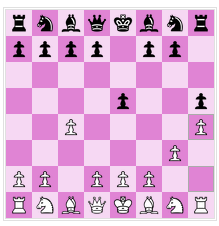
The Modern never looked like this when Ray played it. This version's not so much an Irregular Opening as an opening from a parallel universe where no such thing as regularity exists. By comparison Claridge-Hansen v Pleasants (all the pinkish diagrams are from here) was relatively sensible
in so far as I could work out why the moves were played. It was, however, even more brief [1-0, 21] than the effort above.
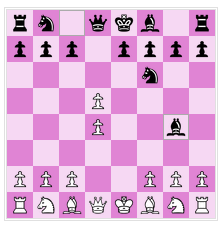
Simons v Brown wasn't irregular in so far as the Blackmar-Diemer possesses a name
but I can't say that I was surprised to see it knocked over in short order [0-1, 21].
Modi v Mason's opening not only has a name, the Portuguese Gambit, I've actually gone so far as to play it -
and to be fair, [1/2, 17] was better than I did.
- they're not taking the tournament sufficiently, or
- they're taking it too seriously, or (most likely)
- neither, and the only person taking this too seriously is the present writer
The Modern never looked like this when Ray played it. This version's not so much an Irregular Opening as an opening from a parallel universe where no such thing as regularity exists. By comparison Claridge-Hansen v Pleasants (all the pinkish diagrams are from here) was relatively sensible
1. c4 e5 2. g3 h5 3. h4
in so far as I could work out why the moves were played. It was, however, even more brief [1-0, 21] than the effort above.
Simons v Brown wasn't irregular in so far as the Blackmar-Diemer possesses a name
1. d4 Nf6 2. f3 d5 3. e4
but I can't say that I was surprised to see it knocked over in short order [0-1, 21].
Modi v Mason's opening not only has a name, the Portuguese Gambit, I've actually gone so far as to play it -
1. e4 d5 2. exd5 Nf6 3. 3. d4 Bg4
and to be fair, [1/2, 17] was better than I did.
Friday, 29 July 2016
I can drive a tractor
Who's up for some tractor chess?
No really.
Saturday August 20, in the very small Spanish village of Hinojosa, in Molina-Alto Tajo district, the Siberia of Spain. In August it'll be a bit warmer than that suggests - and the kick-off's at high noon.
No really.
Saturday August 20, in the very small Spanish village of Hinojosa, in Molina-Alto Tajo district, the Siberia of Spain. In August it'll be a bit warmer than that suggests - and the kick-off's at high noon.
Friday, 22 July 2016
5. Mrs. Fagan's Politics
[This post by Martin Smith]
We start this fifth episode of the life and chess of Louisa Matilda Fagan by going back to May 1913 (and episode 3 once again) and that Hastings Congress dinner. The Mayor of Hastings rose to reply to a toast to his good self and was moved to observe, with mock irony, that:
So just what were the "strong opinions", and so contrary, too, that were provoking such disquiet? What would the ladies play next? The British Chess Magazine of October 1897 may help us on the way to some answers...
We start this fifth episode of the life and chess of Louisa Matilda Fagan by going back to May 1913 (and episode 3 once again) and that Hastings Congress dinner. The Mayor of Hastings rose to reply to a toast to his good self and was moved to observe, with mock irony, that:
"[he] had an idea that Mrs Fagan had strong opinions....the proceedings of some ladies were causing anxiety and if Mrs Fagan could use any influence he would feel greatly indebted to her. The worst of the ladies was - it was not confined to chess players - one never knew what their next move was going to be." (Hastings and St. Leonard's Observer 17 May).Laughter ensued, said the report.
![]() |
| Had strong opinions. Louisa Matilda Fagan published in 1898; but perhaps taken earlier? |
Tuesday, 19 July 2016
No more heroes
And we're back in the tournament room.
We'll never see Viktor Korchnoi there again. Come to that, we'll never see his like again.
I was at that tournament. In fact I was at that analysis session too, sat just a few feet away while Jonathan Rowson and Viktor Korchnoi went through their game.
I don't remember that. But I remember being there.
We'll never see Viktor Korchnoi there again. Come to that, we'll never see his like again.
I was at that tournament. In fact I was at that analysis session too, sat just a few feet away while Jonathan Rowson and Viktor Korchnoi went through their game.
I don't remember that. But I remember being there.
Friday, 1 July 2016
4. Mrs. Fagan's Family
[This post by Martin Smith]
This is the fourth episode of a series on the life and chess of Louisa Matilda Fagan (née Ballard, 1850-1931) - earlier episodes are linked below. So far we have looked at her chess: she emerged on to the domestic scene in 1895, around the time of the formation of the Ladies Chess Club, and pretty much disappeared chess-wise (as did the LCC itself) when war broke out in 1914. She was considered, at some time in that career, to have been the strongest lady playing.
Now, in this episode, we will begin to reconstruct her non-chess biography (although there is - should anyone feel the need - one game of chess), though, be warned, it includes - as always - a fair degree of plausible supposition and guesswork. But before getting on with the job I will come clean and explain my fascination with Louisa Matilda (though surely I'm not the first to be in her thrall).
When looking at this photograph one has to make allowances for the conventions of late Victorian portrait photography which obliged the ladies to present themselves as demure and modest, and with none of the self-satisfaction permitted the male of the species (see painting below). Nonetheless, to me there is something striking about it (taken, as is likely, around 1897) and indeed the other published portraits of Mrs Fagan. In addition to her eye-catching - could we say Italianate - beauty there is an inward sadness that pervades the image. The declination of the lip, the faraway look, the veil of distraction; it is as if she is reflecting on some deep and troubling tragedy - yet without any hint of morbid melancholia. Although she avoids our eye, she faces us, and by extension life and its vicissitudes, with resolute composure and with serene forbearance and tolerance.
Could it be relevant that in none of the reportage, such as it is, of the social side of her chess career (the Congress dinners, the soirées at the Ladies Club), nor even in her BCM obituary (which we might have expected to refer to her personal circumstances and her nearest and dearest) is there scarcely a mention of her husband Joseph George Fagan; nor anyone else as her loyal escort, constant companion, and rock? Of her own published references to Joseph, the most telling comes in the BCM in October 1905, which we will deal with below; and now that we talking of her family life: nor is there any mention of children. This was all a stimulus to my curiosity about the enigmatic Mrs Fagan. So, in this episode we shall begin to try and get to the bottom of it, as we follow her through the long 81 years of her life, and begin to touch on the mores of Victorian society, and religion.
This is the fourth episode of a series on the life and chess of Louisa Matilda Fagan (née Ballard, 1850-1931) - earlier episodes are linked below. So far we have looked at her chess: she emerged on to the domestic scene in 1895, around the time of the formation of the Ladies Chess Club, and pretty much disappeared chess-wise (as did the LCC itself) when war broke out in 1914. She was considered, at some time in that career, to have been the strongest lady playing.
Now, in this episode, we will begin to reconstruct her non-chess biography (although there is - should anyone feel the need - one game of chess), though, be warned, it includes - as always - a fair degree of plausible supposition and guesswork. But before getting on with the job I will come clean and explain my fascination with Louisa Matilda (though surely I'm not the first to be in her thrall).
![]() |
| Mrs Fagan c 1897 |
Could it be relevant that in none of the reportage, such as it is, of the social side of her chess career (the Congress dinners, the soirées at the Ladies Club), nor even in her BCM obituary (which we might have expected to refer to her personal circumstances and her nearest and dearest) is there scarcely a mention of her husband Joseph George Fagan; nor anyone else as her loyal escort, constant companion, and rock? Of her own published references to Joseph, the most telling comes in the BCM in October 1905, which we will deal with below; and now that we talking of her family life: nor is there any mention of children. This was all a stimulus to my curiosity about the enigmatic Mrs Fagan. So, in this episode we shall begin to try and get to the bottom of it, as we follow her through the long 81 years of her life, and begin to touch on the mores of Victorian society, and religion.
Subscribe to:
Comments (Atom)