Chess in Art has been a bit thin on the ground recently. However, a few things of interest have popped up that encourage several visits to our back-catalogue (here and here) - which we'll do over the next few weeks.
Friday, 1 March 2019

Tuesday, 26 February 2019
Brain Drain
Now here's a thing - the latest accounts for the Brain Trust, Ray Keene's fake charity, are out. They're late, but they're out.
What do they tell us? Not much we didn't know already, so if you were expecting all the large donations to have gone to Ray, Tony Buzan and their mates, there is nothing here to disappoint you.

If you look at the notes carefully, you'll be doing more than anybody was when they wrote them, or for that matter when they signed them off, since UK Schools Memory Initiative seems to have become UK Memory Sports Council between the list of grants and the notes to that list. Nevertheless, they were "approved by the Board of Trustees on 20 December 2018" and signed off by Ray, as well as the charity's Independent Examiner, Ray's old business partner David Massey.
I'm not actually sure that anything called the UK Schools Memory Initiative exists at all but no matter, the accounts themselves cite Ray and Tony as having an involvement in these two entities, organisations, bank accounts, whatever they may actually be. They don't suggest the same for the Chinese Memory Championship, perhaps surprisingly as the World Memory Statistics webpage, not updated for a while, trumpets the then-upcoming World Memory Championships, to be held in China, in December 2017

where they duly took place, with Ray and Tony visible in many of the photos.


What do they tell us? Not much we didn't know already, so if you were expecting all the large donations to have gone to Ray, Tony Buzan and their mates, there is nothing here to disappoint you.

If you look at the notes carefully, you'll be doing more than anybody was when they wrote them, or for that matter when they signed them off, since UK Schools Memory Initiative seems to have become UK Memory Sports Council between the list of grants and the notes to that list. Nevertheless, they were "approved by the Board of Trustees on 20 December 2018" and signed off by Ray, as well as the charity's Independent Examiner, Ray's old business partner David Massey.
I'm not actually sure that anything called the UK Schools Memory Initiative exists at all but no matter, the accounts themselves cite Ray and Tony as having an involvement in these two entities, organisations, bank accounts, whatever they may actually be. They don't suggest the same for the Chinese Memory Championship, perhaps surprisingly as the World Memory Statistics webpage, not updated for a while, trumpets the then-upcoming World Memory Championships, to be held in China, in December 2017

where they duly took place, with Ray and Tony visible in many of the photos.


Monday, 18 February 2019
Missing millions
Good spot Rog.

The Chessbase article on the FIDE campaign to be accepted as a sport at the 2024 Olympics is, as it says, a translation of a piece, in German, by Conrad Schormann, on the blog Perlen Vom Bodensee. It has appended to it, though, the text of a FIDE press release

whch as Roger observed, makes our favourite claim, and does so in two places.


We'll just note in passing the date on that press release (12 February, the day before the Chessbase piece) and the fact that it invites us to contact a Véronique Revoy who among other things is General Secretary of the French Chess Federation.
I took up that invitation and last Friday I swapped a few emails with Mme Revoy.

The Chessbase article on the FIDE campaign to be accepted as a sport at the 2024 Olympics is, as it says, a translation of a piece, in German, by Conrad Schormann, on the blog Perlen Vom Bodensee. It has appended to it, though, the text of a FIDE press release

whch as Roger observed, makes our favourite claim, and does so in two places.


We'll just note in passing the date on that press release (12 February, the day before the Chessbase piece) and the fact that it invites us to contact a Véronique Revoy who among other things is General Secretary of the French Chess Federation.
I took up that invitation and last Friday I swapped a few emails with Mme Revoy.
Monday, 11 February 2019
Cut Short
Funny thing is I was just wondering whether to renew my subscription.
I've not seen the first issue of 2019 yet - well, I've seen the front cover

but the rest of it, the last one that I've currently paid for, is late. And if it and when it does turn up, there's not going to be any Nigel Short in it.
This is a good thing.
I'd stopped reading his column some issues back anyway, partly because it really wasn't very well written (too much convoluted phrasing in preference to plain English) but partly because after a few years the combination of ego, obnoxiousness and permanent points-scoring just isn't that compelling any more.
I mean yes, if what you're looking for is controversy
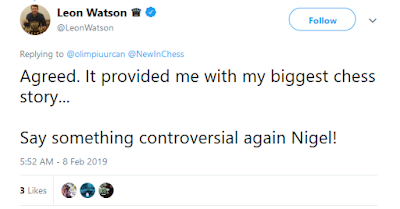
then it's a good thing to have a motormouth on the scene.
But what if you're looking for is for women to be treated with respect? Is that important at all, Leon, or is the controversy the thing?
What if you would like other nationalities to be treated with respect too? What if you find his propensity to bullying and feuding distasteful?
It's not an optional extra, it's the whole man, the whole style. The "controversy" he produces is misogyny, prejudice and bullying. And I think we ought to be able to do better than that.
I'd like that to be the reason he's gone. Of course it isn't, whatever this may actually mean -

but it's the reason why, if and when my copy does turn up, I'll be renewing my subscription.
I've not seen the first issue of 2019 yet - well, I've seen the front cover

but the rest of it, the last one that I've currently paid for, is late. And if it and when it does turn up, there's not going to be any Nigel Short in it.
This is a good thing.
I'd stopped reading his column some issues back anyway, partly because it really wasn't very well written (too much convoluted phrasing in preference to plain English) but partly because after a few years the combination of ego, obnoxiousness and permanent points-scoring just isn't that compelling any more.
I mean yes, if what you're looking for is controversy

then it's a good thing to have a motormouth on the scene.
But what if you're looking for is for women to be treated with respect? Is that important at all, Leon, or is the controversy the thing?
What if you would like other nationalities to be treated with respect too? What if you find his propensity to bullying and feuding distasteful?
It's not an optional extra, it's the whole man, the whole style. The "controversy" he produces is misogyny, prejudice and bullying. And I think we ought to be able to do better than that.
I'd like that to be the reason he's gone. Of course it isn't, whatever this may actually mean -

but it's the reason why, if and when my copy does turn up, I'll be renewing my subscription.
Monday, 28 January 2019
Is this really a good way to promote women's chess?
I doubt it


especially since the Opening Ceremony involved parading round a Miss Gibraltar

once again.
So maybe this observation from last year will do for this year too:


especially since the Opening Ceremony involved parading round a Miss Gibraltar

once again.
So maybe this observation from last year will do for this year too:
...let's go back to our image. An old guy surrounding himself with much younger women.No matter how much money he's spraying about, Brian Callaghan is a sleazy old man.
If you're anything like me, you might think that image wouldn't be happening if he wasn't the guy paying for it to happen.
Sunday, 27 January 2019

Tuesday, 22 January 2019
Mechanical reproduction

Roger was kind enough to comment on last Monday's post, on the apparent discovery by Chess and Bridge that the Times chess correspondent produces rubbishy books in which material is copied and pasted from previous work and their subsequent decision to cease to stock his latest effort.
The question came up as to whether any of Ray's other stuff is still on the shelves there. I'm about a thousand kilometres away and not in a position to check, but Roger employed the shop's handy search function, and, apart from the volume at the centre of the present controversy, located
a couple of old books on Staunton and the Deep Blue match.I've nothing against the Staunton, which I've not seen, but it's from several decades ago and for all I know is a fine effort, since Ray used to be capable of that back then. As for the Deep Blue book

I hadn't seen it either, but by chance, the US publisher has put the entire thing online, so I played around with the notes to see if and where - all right, where - they had been published prior to appearing in the book.
This isn't as much fun as it used to be, since The Spectator's archive has now disappeared behind a paywall, so you only get a brief look at the original column. You can't screenprint the notes and put them next to the reused versions any more. Nevertheless, the Google searches tell their own story.

Man Versus Machine

What happens when you Google
and both this and the following excerpt are from the notes to first game.


You'll find others if you look.
Monday, 21 January 2019
Three years ago Today...

...since the Today Programme ran an interview with Nigel Short about a ban on chess that hadn't happened.
(And within a couple of years, he'd be playing there himself.)

Tuesday, 15 January 2019
No way Ray
Well this is amusing.

But also a little curious.
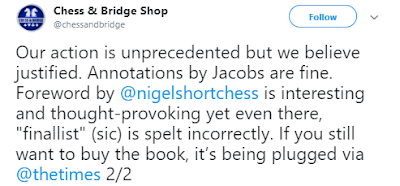
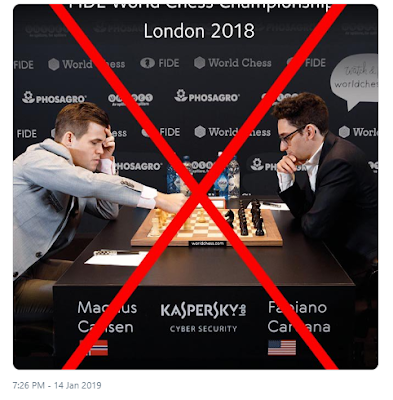
Good, Ray's book got the push. Great news. Excellent.
Still, one wonders - what did Chess and Bridge think the book was going to be like? Did they think there was any chance in the world that it was going to be anything other than a cut-and-paste job?
Course they didn't. They knew what Ray is like because everybody knows what Ray is like. They must have known, before they received the book towards the end of 2018, that it was going to be precisely the sort of thing than which "our customers deserve better" halfway through January of 2019.
So - unless the proprietor, having previously thought Ray was some kind of reputable character, suddenly read Olimpiu's review and it opened the doors of perception - what's brought this on now?

But also a little curious.


Good, Ray's book got the push. Great news. Excellent.
Still, one wonders - what did Chess and Bridge think the book was going to be like? Did they think there was any chance in the world that it was going to be anything other than a cut-and-paste job?
Course they didn't. They knew what Ray is like because everybody knows what Ray is like. They must have known, before they received the book towards the end of 2018, that it was going to be precisely the sort of thing than which "our customers deserve better" halfway through January of 2019.
So - unless the proprietor, having previously thought Ray was some kind of reputable character, suddenly read Olimpiu's review and it opened the doors of perception - what's brought this on now?
Monday, 14 January 2019
Delayed awareness

There's an odd little thing that I'm not too fond of tucked away in the latest ECF monthly email.

It's on a Word document in an ECF email, so if you're a member you may have seen it already. Actually, if you're not a member you may also have seen it already, since you can read the whole thing here in a link from 2015.
Why the ECF are treating us to "an interesting article from John Foley around the definition of chess as a sport" is left unexplained, but it may be connected to a short line in the (less than interesting) piece which says
There is an emerging awareness of the effectiveness of chess in delaying the onset of Alzheimers.Should that look familiar, it may be because Jonathan wrote about it back in 2015, specifically here and here. Do read, or re-read his pieces, but to cut a couple of longer stories short, there is not "an emerging awareness of the effectiveness of chess in delaying the onset of Alzheimers" because there is no apparent evidence that it does.
Why are we talking about this again? I'm guessing it may be connected to a recent press release from the Health and Social Care Secretary on the subject of dementia.

I confess my heart sank on seeing the press release, not because it says anything that's wrong as such, but because it brings up the subject of "memory and thinking games" and of chess specifically, and experience leads me to believe that whenever chess and dementia are linked, people start saying things I'm not sure they ought to. The press release came out on Wednesday 5 December: this was Saturday 8.

And this was Tuesday 11.

The key line in the report might be this:
No studies have shown that brain training prevents dementia.
Thursday, 10 January 2019
Barry remorse
Why did nobody tell me about this major publishing event?
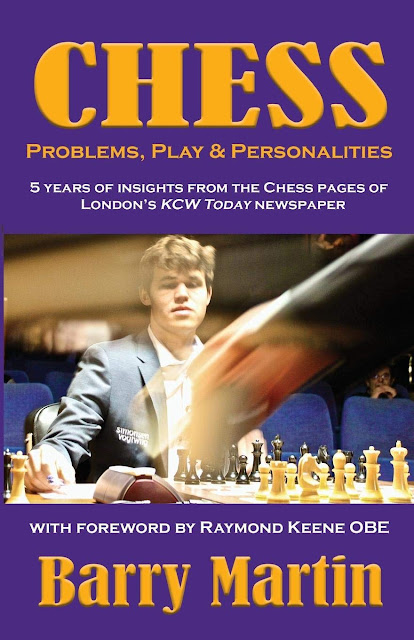
Who's Barry Martin? He's a minor figure in the history of British art over the past half-century but a relatively major figure in the history of Ray Keene's circle of friends and cronies. He also has an interest in chess, and this combination - Ray, art and chess - is nicely illustrated by this book cover from a decade or so back.
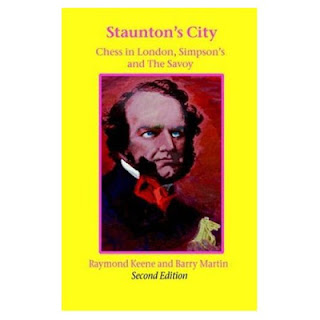
Apparently Barry writes a chess column in his local paper. I say "apparently" not because I doubt its existence, but because I doubt its relevance, given that the only person I have ever seen refer to this column is Ray himself. Fitting, then, that Ray and Barry should continue their collaboration with a book compiled from Barry's columns, of which Ray himself is the only known reader. It is available in all good bookshops, says the ad. I think I need to say "apparently" again.
There's an introduction by your friend and mine, promising that

Among the other tendentious claims made by our normally reliable guide is that Barry
Ray also tells us:

Funny, it seems these days that every time you come across one of Nigel or Ray, you come across the other too.

Who's Barry Martin? He's a minor figure in the history of British art over the past half-century but a relatively major figure in the history of Ray Keene's circle of friends and cronies. He also has an interest in chess, and this combination - Ray, art and chess - is nicely illustrated by this book cover from a decade or so back.

Apparently Barry writes a chess column in his local paper. I say "apparently" not because I doubt its existence, but because I doubt its relevance, given that the only person I have ever seen refer to this column is Ray himself. Fitting, then, that Ray and Barry should continue their collaboration with a book compiled from Barry's columns, of which Ray himself is the only known reader. It is available in all good bookshops, says the ad. I think I need to say "apparently" again.
There's an introduction by your friend and mine, promising that
On the back cover, we see Barry in play against a vital link to the chess art traditions of the past, his opponent being Marcel Duchamp’s widow, Mme Teeny Duchamp herselfwhich judging by what I can see on Amazon, may not be a promise fulfilled.
Among the other tendentious claims made by our normally reliable guide is that Barry
has also gained a world chess ranking. In Duchamp's time, such ratings had not been invented, so Barry is the only artist on the planet who has achieved this accolade.Your suggestions are invited for candidates who would disprove this assertion. So, indeed is your assistance in demonstrating that Barry possesses such a thing, since I can't locate one. (Maybe he had one in the past. No doubt he did, for if this is not about living in the past, what is?)
Ray also tells us:
the theme of chess, of course, is a prominent thread throughout his oeuvre, ranging from the biodegradable potato chess setI would genuinely like to know more about this set - I've come across it mentioned before, and wanted to write about it
through portraits distributed by The Times of Garry Kasparov and Nigel Short.Well well, it's Nigel again. That's right about the portrait, mind, and Nigel crops up at the artist's launch - Chess stars flock to Barry Martin's book launch, it says here.

Nigel in company
Funny, it seems these days that every time you come across one of Nigel or Ray, you come across the other too.
Monday, 7 January 2019
Dive bomb
What nonsense is this?

It's not new nonsense, that's for sure: see for instance this piece from August 2016 (and indeed this one from April 2012) which I wrote after coming across a similar nonsense in the Financial Times, allowing Etan Ilfeld to repeat various implausible claims such as this.

Remarkably I am yet to come across the results from the Spanish league in the sports papers here. Perhaps I could catch them on breakfast television.
Mr Ilfeld has been operating this particular hoax for seven years now. Obviously its existence as a genuine, functioning sport is nil. As a genuine, functioning way of getting Mr Ilfeld's name in the media it has performed a little better: the notes to his Wikipedia entry list the Telegraph and Toronto Star among the marks, along with Chess Life and the Financial Times as above.
Also Chessbase, who have always been prepared to write up any old rubbish, and scrolling down their 2016 piece I was delighted to find an old friend

from the similar chessboxing hoax.

It's not new nonsense, that's for sure: see for instance this piece from August 2016 (and indeed this one from April 2012) which I wrote after coming across a similar nonsense in the Financial Times, allowing Etan Ilfeld to repeat various implausible claims such as this.

Remarkably I am yet to come across the results from the Spanish league in the sports papers here. Perhaps I could catch them on breakfast television.
Mr Ilfeld has been operating this particular hoax for seven years now. Obviously its existence as a genuine, functioning sport is nil. As a genuine, functioning way of getting Mr Ilfeld's name in the media it has performed a little better: the notes to his Wikipedia entry list the Telegraph and Toronto Star among the marks, along with Chess Life and the Financial Times as above.
Also Chessbase, who have always been prepared to write up any old rubbish, and scrolling down their 2016 piece I was delighted to find an old friend
from the similar chessboxing hoax.

Friday, 4 January 2019
Broadmoor Chess - A Feast of Stephens
A bit late for Boxing Day this post may be....but even further back in the mists of time, on the Streatham and Brixton Chess Blog, we examined the chess played by the patients of Broadmoor high-security hospital at Crowthorne, west of London - though it would be more accurate to say that we examined the patients who played the chess, rather than the play itself. It all started with Richard Dadd, Victorian artist and patricide, who painted - in 1857 - a puzzling chess-themed picture 'The Child's Problem'. We've shown it before, we analysed it at length in several posts, and here it is again...
The series continued with other Broadmoor chessers: Edward Oxford (who took a pot-shot at Queen Victoria - or did he? See Postscript below), Reginald Saunderson (a Jack the Ripper might-have-been) and Robert Coombes (the "Wicked Boy" of Kate Summerscale's excellent recent book). It is especially pleasing to see that another of our subjects, problemist Walter Stephens (1857-1947) - he shot his wife while he was 'sodden with drink' - has come to the attention of Bob Jones, who adds to the Stephens story in a fascinating article in the January 2019 issue of Chess magazine. It now becomes the tale of two Stephens....but we'll not be a spoiler in relation to the other one: for that you really should get hold of Chess.
Walter Stephens of Clapham Park (hence our particular local interest) was to become a dedicated problemista at some time after confinement 'at his Majesty's pleasure' in Broadmoor in 1905. He became a competent solver winning, for example, in January 1926, the Grantham Journal's 19th Solving Tourney, and his own compositions were published widely in the newspaper chess columns and the BCM - often declaring himself as W. Stephens of 'Crowthorne' or 'Broadmoor'. Irked by the lack of recognition of the good work done at the hospital he had complained in a letter to the Daily Telegraph in July 1922 (alongside two of his problems) about "the piffle" that had been written about the place.
Now more has come to light about Broadmoor Stephens, thanks on the one hand to a piece of serendipidy that befell Bob, and on the other to some local newspaper reports that befell me.
 |
| This is how the now-faded picture may have looked originally, as suggested by reader David Roberts. |
The series continued with other Broadmoor chessers: Edward Oxford (who took a pot-shot at Queen Victoria - or did he? See Postscript below), Reginald Saunderson (a Jack the Ripper might-have-been) and Robert Coombes (the "Wicked Boy" of Kate Summerscale's excellent recent book). It is especially pleasing to see that another of our subjects, problemist Walter Stephens (1857-1947) - he shot his wife while he was 'sodden with drink' - has come to the attention of Bob Jones, who adds to the Stephens story in a fascinating article in the January 2019 issue of Chess magazine. It now becomes the tale of two Stephens....but we'll not be a spoiler in relation to the other one: for that you really should get hold of Chess.
Walter Stephens of Clapham Park (hence our particular local interest) was to become a dedicated problemista at some time after confinement 'at his Majesty's pleasure' in Broadmoor in 1905. He became a competent solver winning, for example, in January 1926, the Grantham Journal's 19th Solving Tourney, and his own compositions were published widely in the newspaper chess columns and the BCM - often declaring himself as W. Stephens of 'Crowthorne' or 'Broadmoor'. Irked by the lack of recognition of the good work done at the hospital he had complained in a letter to the Daily Telegraph in July 1922 (alongside two of his problems) about "the piffle" that had been written about the place.
Now more has come to light about Broadmoor Stephens, thanks on the one hand to a piece of serendipidy that befell Bob, and on the other to some local newspaper reports that befell me.
Thursday, 27 December 2018
Ace Of Wands
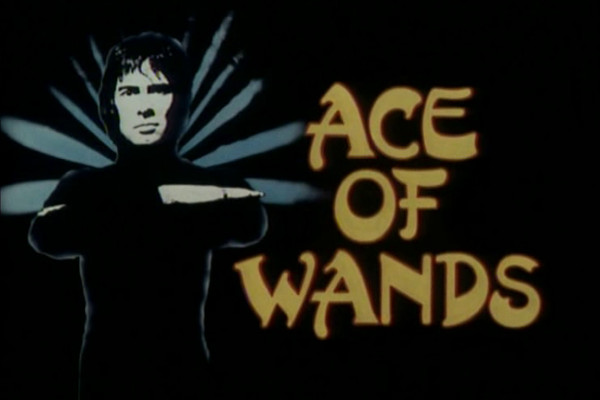
Now here's frustrating.
While I was researching yesterday's piece - or trying to - I came across this link, via one set of search terms or another, I forget what.
Just because I thought I might as well, I put chess into its search box, and flicked through to one of the references. And this is what I found.
Ace of Wands concerned Tarot, who was a master magician and telepathic super sleuth, who would use his gifts in order to fought evil criminals, such as Madam Midnight and Mr. Stabs...This sounds fantastic, you are saying. Show us some pictures, you are saying.
...a diamond gives its name to the final second season story, "The Eye of Ra". It is a diamond reputed to have magical powers, one of which is the ability to turn people into chalk statuettes. A wheelchair bound chess-master Ceribraun (Oscar Quitak) wants to obtain the diamond. He tries to force Tarot to steal it for him by kidnapping Mr. Sweet and making it appear he has been turned to chalk. His statuette is then knocked over and smashed by accident causing Tarot to think Mr. Sweet has been killed. Lulli, as well as Mr. Sweet, finds herself a prisoner of Ceribraun and his servant, Fredericks, and in trying to rescue her, Tarot finds himself on Ceribraun's giant robotic chess board being crushed by two huge chesspieces.
Alas, there are none to show.
They were wiped. Well, the first two series of the show were wiped, and our episode was the final segment of the second series. "This story no longer exists."
Even that's not quite true: three parts of it can be found on YouTube, but in audio form only. (I've not listened to them.) But no footage, apparently, nor any publicity shots, photos taken on set, nothing to show us our wheelchair-bound chess master, or our hero under threat from gigantic robotic chess pieces.
I'd never heard of Ace of Wands. I was a touch young for it, being six when these shows were broadcast, though I do remember a little of The Tomorrow People, which seems in some senses to have replaced it. (If any comparison can be made with Doctor Who, I saw my first episodes of that show in January 1972, just a few months later.)
Too late, too late. There's a few web pages available about the show, but they all say essentially the same thing, that while the third series is available, the first two are (almost entirely) lost to us forever.
Oscar Quitak is still with us: for all I know, he might have some old photos, but as he's in his nineties and lives on Ibiza, I don't think I'll be troubling him to ask. His other credits, coincidentally, include the 1983 ITV series Chessgame.

I don't reckon there's any chess in it.
Wednesday, 26 December 2018
A second look
You might recall this piece from early last year, in which I was, ah, sceptically non-committal about a Guardian story involving Donald Sutherland, not previously known to me as a chess enthusiast, intervening in a game between two newlyweds to point out a win in what appeared to be a hopelessly lost position.
It may be that I scoffed too soon. I'm indebted to Mike in comments for finding an interview with Paul Darrow, most famous for playing Avon in Blake's Seven and, as such, no stranger to hopelessly lost positions.

What does Darrow have to tell us? It transpires that he was once in a series called The Odd Man - during which time he played chess with another member of the cast - none other than our man Donald Sutherland. How did it go?
Not well for Darrow.
So not only does Sutherland play - at least, he did in 1963, and in 2006 - but maybe he can play a little bit better than the average near-beginner.
Still, this leaves us with the mystery of why it is that I have been able to find so little on Donald Sutherland's interest in the game, given that normally, if a celebrity so much as looks at a chessboard, we hear how much of a chess fan they are for years afterwards.
I got excited by this, for a moment, but there's no more to it than Donald saying "the chess game begins", and it's a metaphorical game that he's referring to.
This is more to the point: Donald says
But beyond that, I'm really struggling.
Kiefer, on the other hand, no problem.

It may be that I scoffed too soon. I'm indebted to Mike in comments for finding an interview with Paul Darrow, most famous for playing Avon in Blake's Seven and, as such, no stranger to hopelessly lost positions.

What does Darrow have to tell us? It transpires that he was once in a series called The Odd Man - during which time he played chess with another member of the cast - none other than our man Donald Sutherland. How did it go?
Not well for Darrow.
So not only does Sutherland play - at least, he did in 1963, and in 2006 - but maybe he can play a little bit better than the average near-beginner.
Still, this leaves us with the mystery of why it is that I have been able to find so little on Donald Sutherland's interest in the game, given that normally, if a celebrity so much as looks at a chessboard, we hear how much of a chess fan they are for years afterwards.
I got excited by this, for a moment, but there's no more to it than Donald saying "the chess game begins", and it's a metaphorical game that he's referring to.
This is more to the point: Donald says
...diplomacy is diplomacy, but...Henry Kissinger once described it as a chess game. It's not a chess game. Chess is war. Diplomacy is supposed to be dealing.which I think is the sort of thing that somebody interested in chess might say.
But beyond that, I'm really struggling.
Kiefer, on the other hand, no problem.

Monday, 10 December 2018
600 million reasons not to read Ray's new book
I'm sure you weren't going to touch it anyway, but I'm also sure you'll be as pleased as I was to learn from Olimpiu's review that everybody's favourite chess fraud has been happy - again - to repeat everybody's favourite fraudulent chess statistic.
As Olimpiu observes, Ray's said this already, in Synapsia, the magazine of his fraudulent Brain Trust charity:

and he said it again in the Spectator in September, sans the billion smart phones.

I've not seen the book, but according to Olimpiu this whole section (World Chess Comes to London) is copied out word-for-word from the Synapsia article.
Of course it is, it's what he does: but I hope on this occasion he found time for publication to check his dates.
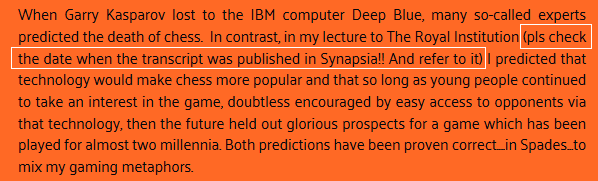
chess can now boast 11 million games played online, worldwide every day; 600 million active chess players and no fewer than one billion smart phones in use with chess apps!Well, he's happy to repeat, full stop.
As Olimpiu observes, Ray's said this already, in Synapsia, the magazine of his fraudulent Brain Trust charity:
and he said it again in the Spectator in September, sans the billion smart phones.
I've not seen the book, but according to Olimpiu this whole section (World Chess Comes to London) is copied out word-for-word from the Synapsia article.
Of course it is, it's what he does: but I hope on this occasion he found time for publication to check his dates.
Monday, 3 December 2018
Seventh impressions
Alex Spencer, a schoolteacher and member of Streatham and Brixton Chess Club, went to the Carlsen v Caruana match, the first such event he's attended. Thanks very much to him for permission to reproduce them here. - ejhWorld Chess Championship 2018
Game 7
Sunday 18th November
Magnus Carlsen (white) v Fabiano Caruana (black)
These are just a collection of my thoughts as I sat staring at both players through the double layer of protective glass for 3 and a half hours.
Apologies in advance to the chess experts. I’m writing this to be less about the chess and more about my observations on the players and the whole experience of staring at two people non-stop for so long.
Notes on Magnus Carlsen (opening thoughts)
- 27. Norwegian.
- World number 1.
- Thought by some to be the best chess player ever.
- One shirt button undone.
- Bit of a bum chin (only a little bit).
- Bit of hair gel.
- Muscular, sporty physique.
- Looks like a Norwegian footballer. Maybe a right midfielder for Southampton who has had 6 months out with a bad knee injury and is struggling to get back his peak fitness.
- Light pink shirt.
- Black suit.
- Brown belt.
- Black shoes.
- ‘PLAY MAGNUS’ sponsor on his upper right arm jacket.
- ‘Simonsen Vogtwiig’ (SP?) on his right breast pocket. Another sponsor?
- Magnus takes his jacket off after move 12. Oh no! What about the sponsor… It’s OK. He hangs the jacket on the back of his chair so the sponsor is showing. And his shirt has the same sponsors in the same locations so now it’s double sponsor time.
- [Has he done that because he’s stressed? Hot? Surely not thinking about the double sponsorship.]
- Studying his face, he looks like a boy on the first day of a big secondary school. A boy who was the smartest kid in primary school. By far. A boy who was worried he wouldn’t be the smartest kid anymore. But he’s halfway through his first day and he now knows he’s still the smartest kid.
- Magnus sits normally. Then with his left leg tucked under his right leg. (Like my girlfriend sits). Then 3 moves later with his right leg over his left leg. (Like I sit if I’m pretending to be mature).
- Magnus goes to make a move but pulls his hand away. It’s good to see that the best still have so much doubt and indecision.
- He plays with a taken pawn in his hand through a lot of his thinking.
- I imagine if he was a poker player he’d be constantly manipulating the chips between fingers in quick, regular patterns.
- Looks unimpressed by … 12 Qe7.
- Glasses.
- No hair gel.
- Short, curly, fluffy dark hair.
- Light blue shirt. It looks like a block of light blue. But then it’s actually a tiny check of light green and white. A nice shirt but not a sleek shirt.
- Navy suit. No sponsor
- [I noticed much later during the press conference that he has a SLC logo on his blazer breast pocket. St. Louis Chess Club]. But no sponsor as such.
- Looks like the kid at school who is not massively popular but happy with his lot.
- He’d be the best at science. Because science is about how hard you work.
- But is he actually immensely talented? It’s hard to tell because he works so hard.
- Sits ‘normally’ throughout. Both feet flat on the ground. Often on the edge of his seat with his elbows on the table. Alert. Very alert.
- Is this the most efficient way to sit? More oxygen to your brain? Why is Magnus clogging all his oxygen supplies with his demi-yoga pose?
- Clean shaven like Magnus. But Magnus looks like he’s shaven. Fabi looks like he doesn’t have to shave.
- Caruana looks like a cross between Screech from Saved by the Bell and Mark Zuckerberg. But shorter than both of them. And more steely than both of them. And smarter. Fabi is growing on me the more I look at him. I wanted him to be the guy who put up a good fight and got beat. But there’s a nice confidence to his manner. He knows everyone’s here to see Magnus. But that’s ok. That’s how it’s always been.
- 26 years young.
- They’ve both been playing chess round the world since they were tiny but whereas Carlsen seems to carry that around with him, Fabi looks like he’s just hitting his stride.
- Both players seem to relax their posture when the other one steps outside (presumably to go to the toilet) Or maybe to eat. I didn’t see either player eat. Maybe they’re not allowed to eat. Is it like exams? You can drink water but no eating? One of their games lasted 7 hours. You’d want at least a banana.
Sunday, 2 December 2018
605 million reasons not to believe what you read in Wired
Jonathan draws our attention to this piece from Wired a few days ago, in which the author, as well as being perhaps the only person on the planet who thinks that Spassky beat Fischer

(an error which to their credit they have now corrected)

also appears to believe that the planet contains many hundreds of millions more chess players than is intrinsically likely.

Maybe she was unwise enough to read Dylan Loeb McClain - or, more likely, and even more unwise, to believe what Ilya Merenzon told her.

(an error which to their credit they have now corrected)

also appears to believe that the planet contains many hundreds of millions more chess players than is intrinsically likely.

Maybe she was unwise enough to read Dylan Loeb McClain - or, more likely, and even more unwise, to believe what Ilya Merenzon told her.
Subscribe to:
Posts (Atom)