Jonathan draws our attention to this piece from Wired a few days ago, in which the author, as well as being perhaps the only person on the planet who thinks that Spassky beat Fischer
(an error which to their credit they have now corrected)
also appears to believe that the planet contains many hundreds of millions more chess players than is intrinsically likely.
Maybe she was unwise enough to read
Dylan Loeb McClain - or, more likely, and even more unwise, to believe what Ilya Merenzon told her.
Sunday, 2 December 2018
Friday, 30 November 2018
Les Chesseurs Britanniques de Paris: Part 9 Initial Confusion Resolved
One year on since the last episode, this is a belated addition to
the sequence of posts recovering the forgotten story of the British
Chess Club of Paris.
The Club flourished in the City of Light from 1926 up to the War of 1939-45
providing chessic divertissements for ex-pat and visiting
British players. It joined the local leagues, took part in Parisian/French chess
administration, and ran its own internal tournaments. Through lean years and
years of plenty, the BCCP kept the flag flying for les jouers
d'échecs britanniques - although chess wasn't their only
amusement: they enjoyed a bon repas as well...

The Club's most high profile event was a team consultation game-by-cable
against the Manhattan Chess Club in 1931 (the BCCP lost). There was a fulsome account of the
event in the British Chess Magazine, probably submitted by the
Club's enthusiastic publicity manager George Langelaan (the originator of the spoof coat-of-arms above). Post-war he became a sci-fi author best known for The
Fly; he also wrote (in French) a chess-themed
robo-shocker. Among other members of the Club there were - for greater or
lesser periods of time - one-time Scottish Champion H.K. Handasyde, then
domiciled in Paris; Laurent Henry Mortimore who went on to serve with
distinction in the war (to be decorated by both the British and the French, as
was Langelaan also); and briefly - before he was expelled from France as a spy
- the notorious and self-promoting occultist Alesteir
Crowley. He was a decent player, as he was the first to admit; though it is
doubtful that he was good enough to beat Tartakover in a Paris league match as
he claimed - even with the spirited assistance of "the Baron" (who Crowley consulted in the gents).
We also came across a Mr Wechsler, who briefly played for the BCCP
in 1929. Notwithstanding the generous help of Dominique Thimongier of the
authoratitive Heritage des Echecs Francais, we couldn't quite pin down his actual
name among the chess-playing Wechsler family, three of whom were active on the
British chess scene in the 1920s and 1930s. They played with various and
confusing initials, sometimes in the same events.
So which of them was it who séjourned in Paris? And why? Now the truth about the
Wechsler of the BCCP can be told.
Wednesday, 28 November 2018
Lucky Thirteen
I think on reflection I agree with myself.
On principle I'm not against tie-breaks, as a system it seems - in and of itself - better than the alternatives, but as with penalty kicks in football, the problem arises when the tie-break system begins to affect the match itself, to such an extent that the match almost becomes subordinate to the tie-breaker.
Whether we've reached that point or not is a matter of debate. For all I know the next match is going to finish 5-3 with four draws and we'll wonder what all the fuss was about. What isn't a matter of debate, I don't think is that if there wasn't a tie-break coming up, this
doesn't happen.
It's the moment we've all been waiting for - the last game, the match level, one player pressing, one player fighting for his life, and really there shouldn't be anywhere to go from here but play.
So maybe there shouldn't be anywhere to go from here, no escape route, no play-offs.
On principle I'm not against tie-breaks, as a system it seems - in and of itself - better than the alternatives, but as with penalty kicks in football, the problem arises when the tie-break system begins to affect the match itself, to such an extent that the match almost becomes subordinate to the tie-breaker.
Whether we've reached that point or not is a matter of debate. For all I know the next match is going to finish 5-3 with four draws and we'll wonder what all the fuss was about. What isn't a matter of debate, I don't think is that if there wasn't a tie-break coming up, this
doesn't happen.
It's the moment we've all been waiting for - the last game, the match level, one player pressing, one player fighting for his life, and really there shouldn't be anywhere to go from here but play.
So maybe there shouldn't be anywhere to go from here, no escape route, no play-offs.
Tuesday, 27 November 2018
A billion reasons never to believe what Ilya Merenzon says
Monday, 26 November 2018
Forty Years On
Hey, when I posted yesterday I assumed Ray's new book was going to be some kind of Hardinge Simpole nonsense.
But no! It turns out that he's writing for an almost reputable publisher.
When I say "almost reputable", I mean "disreputable" of course, which is to say that since most of Ray's prodigious thieving has taken place from Everyman authors, it's pretty tawdry of them to publish the thief in question, not that we would expect any better.
I see from the cover that Byron's on board, presumably to do any actual writing that's required, not that that's likely to be very much. I think we all assume this is going to be a cut-and-paste job, with "History of the World Chess Championship" looking like the giveaway here.
Anyway, one wonders what this is about - presumably, on one level at least, it's an attempt to relive his controversial glories from forty years ago
when his instant book set him on a path of writing tat that has kept him going, between schemes and scams, ever since.
But I guess behind that, there's some desire to become respectable again, to be somebody who doesn't have to rely on the company of his dubious friends to assure him that he's not an embarrassment. And maybe we have to watch out for that, because if you ask me, there's plenty of people in English chess who would welcome him back tomorrow, on the grounds that it doesn't matter who he's stolen from, as long as he hasn't stolen from them.
But what Everyman's excuse is, God only knows.
But no! It turns out that he's writing for an almost reputable publisher.
When I say "almost reputable", I mean "disreputable" of course, which is to say that since most of Ray's prodigious thieving has taken place from Everyman authors, it's pretty tawdry of them to publish the thief in question, not that we would expect any better.
I see from the cover that Byron's on board, presumably to do any actual writing that's required, not that that's likely to be very much. I think we all assume this is going to be a cut-and-paste job, with "History of the World Chess Championship" looking like the giveaway here.
Anyway, one wonders what this is about - presumably, on one level at least, it's an attempt to relive his controversial glories from forty years ago
when his instant book set him on a path of writing tat that has kept him going, between schemes and scams, ever since.
But I guess behind that, there's some desire to become respectable again, to be somebody who doesn't have to rely on the company of his dubious friends to assure him that he's not an embarrassment. And maybe we have to watch out for that, because if you ask me, there's plenty of people in English chess who would welcome him back tomorrow, on the grounds that it doesn't matter who he's stolen from, as long as he hasn't stolen from them.
But what Everyman's excuse is, God only knows.
Sunday, 25 November 2018
Thursday, 22 November 2018
Monday, 19 November 2018
600 million reasons Professor Tyler Cowen should know better
Oh God, not again.
Who is it this time?
It's Tyler Cowen, who is an actual professor of economics and an actual chess player
and should therefore know better. But he doesn't.
No, he hasn't made the claim himself: but he's reported it, uncritically, without so much as a link to support it and without so much as a word to cast doubt on it.
Which is something, I reckon, he shouldn't do, either as a chess player or a professor of economics.
So why did he?
Let's ask him.
Who is it this time?
It's Tyler Cowen, who is an actual professor of economics and an actual chess player
and should therefore know better. But he doesn't.
No, he hasn't made the claim himself: but he's reported it, uncritically, without so much as a link to support it and without so much as a word to cast doubt on it.
Which is something, I reckon, he shouldn't do, either as a chess player or a professor of economics.
So why did he?
Let's ask him.
Friday, 16 November 2018
The Other Chess Action
While Magnus and Fabiano were squaring up for Game 2 last Saturday, there was some other chess action not a mile away - at the Wallace Collection, where Rupert Dickens took us on a masterly tour de force of Chess in Art: not an easy thing to pitch to an audience of art lovers (with, perhaps, no particular skill in the game) and chess players (with, perhaps, only a sketchy appreciation of the genre). However, our guide excelled in both departments and never looked like falling off the tight rope, though we were all relieved at the early reassurance that it was not to be a seven-hour torture.
Wednesday, 14 November 2018
"Some blonde"
Right, but was anybody actually surprised that Rex Sinquefield should speak boorishly about women?
He's a sinister political figure and if you wanted to know what he thinks about women, you could do worse than check out how he responded to Todd Akin's "legitimate rape" remarks:
He doesn't get much scrutiny, for reasons we all understand. But when we don't talk about the people who give us money, because they give us money, what does that make us?
Tuesday, 13 November 2018
Pop go the weasels
Whose crony is who?
Since reform of FIDE is underway, I wonder if the old slogan, gens una sumus, could be replaced with....well I'm afraid my Latin (O-Level, Grade B, 1981) isn't what it once was, so how do you translate it doesn't matter if you're a thief as long as you steal from someone else?
Monday, 12 November 2018
Thirty-Minute Theatre
This is quite an eye-opener.
This is pretty special too.
I'd be surprised if this was entirely within the law, although I don't suppose we'll ever find out - even if anybody were to try their luck in court I don't suppose there'll be much trace of AGON as a functioning organisation once this match is over.
I was going to say something like "and that was always the plan", but I don't imagine there's ever been a "plan", as such, just a way of doing things, and this is it.
This is, obviously, right:
It's not incompetence because it's not an accident. And the disinterest in paying spectators has always been an overt feature of the business model, ever since AGON first emerged at Simpson's, six years ago - at an event closed to the public.
Maybe it'd have been better if they did it that way, than charge seventy nicker for half an hour of chess. Either way is a monumental screw you to the chessplaying public. Go on, get these people hence.
Sunday, 11 November 2018
Saturday, 10 November 2018
Friday, 9 November 2018
Monday, 5 November 2018
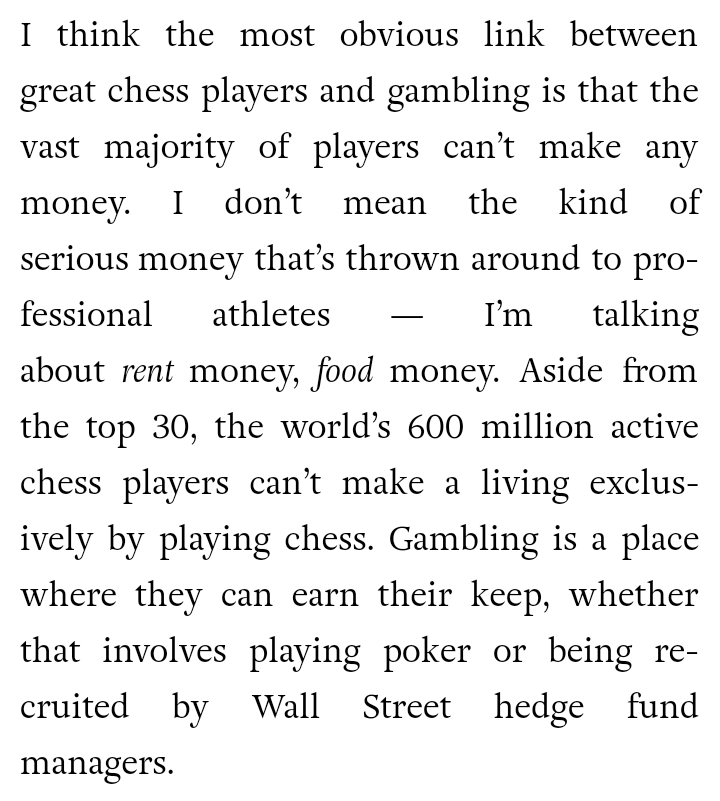
600 million and one reasons not to read Brin-Jonathan Butler
Some clown called Brin-Jonathan Butler has written a book about the last world championship match. Can I be bothered even to give you the title or put an image up?
I cannot.
Why not?
Because the author is interviewed in the Los Angeles Review of Books, and here's a passage from the interview.
Yes, indeed.
The name rang a bell though. Where had I seen that name before?
Ah yes. "It's really good."
It really isn't.
EDIT: There's more.
I cannot.
Why not?
Because the author is interviewed in the Los Angeles Review of Books, and here's a passage from the interview.
Yes, indeed.
the world’s 600 million active chess players.That's as far as I felt I needed to read: if you don't know any better than that, you don't know enough to be worth reading. Simple as that.
The name rang a bell though. Where had I seen that name before?
Ah yes. "It's really good."
It really isn't.
EDIT: There's more.
Friday, 2 November 2018
Or not
The new CHESS is out
and there's eleven pages available for anyone to read, including Malcolm's editorial (of which more, possibly, at a later date) and a bunch of book reviews, among which can be found a short review of yet another book by Cyrus Lakdawala, the worst chess writer publishing in English. A very short review.
Still, it probably took longer to write than the book did.
Anyway, for some reason an Amazon ad for the book turned up on my screen earlier so I took a little glance via the Look Inside function and -
- Good Lord, he's quoting Shakespeare again.
Or to get it right (as Lakdawala does not) he's misquoting Shakespeare again.
and there's eleven pages available for anyone to read, including Malcolm's editorial (of which more, possibly, at a later date) and a bunch of book reviews, among which can be found a short review of yet another book by Cyrus Lakdawala, the worst chess writer publishing in English. A very short review.
Still, it probably took longer to write than the book did.
Anyway, for some reason an Amazon ad for the book turned up on my screen earlier so I took a little glance via the Look Inside function and -
- Good Lord, he's quoting Shakespeare again.
Or to get it right (as Lakdawala does not) he's misquoting Shakespeare again.
Tuesday, 30 October 2018
600 million reasons not to read Dylan Loeb McClain
Anybody remember when Dylan Loeb McClain was a proper journalist?
Well those times ain't no more.
[Thanks to Adam Ponting in comments.]
Well those times ain't no more.
[Thanks to Adam Ponting in comments.]
Friday, 26 October 2018
Monday, 22 October 2018
Boarders
I've been thinking about this image a bit. It comes from a documentary called The Making Of Them, screened by the BBC in 1994, about young boys at a boarding school.
The documentary itself is relatively gentle with its subject, if we're considering the subject as the school as well as the boys who it films there. (Viewers may not feel the same way.) This is not something that can be said of the book which recommended it, Alex Renton's Stiff Upper Lip, a genuinely angry, excoriating and most of all well-informed attack on the practice, almost unique to Britain, of sending children in large numbers to boarding schools.
Renton's work is a litany of physical, sexual and psychological abuse of boys by other boys, boys by older boys and boys by adults, and if it is uncomfortable reading, that is not a great deal of suffering compared to what it describes. This isn't something you see in The Making of Them and viewers have to locate their own signals to tell them about the happiness, or otherwise, of the stranded boys.
Which leads me on to the image, or rather the sequence, that interested me. It's worth watching the whole documentary, of course, but what caught my eye occurs just after 31 minutes.
The documentary itself is relatively gentle with its subject, if we're considering the subject as the school as well as the boys who it films there. (Viewers may not feel the same way.) This is not something that can be said of the book which recommended it, Alex Renton's Stiff Upper Lip, a genuinely angry, excoriating and most of all well-informed attack on the practice, almost unique to Britain, of sending children in large numbers to boarding schools.
Renton's work is a litany of physical, sexual and psychological abuse of boys by other boys, boys by older boys and boys by adults, and if it is uncomfortable reading, that is not a great deal of suffering compared to what it describes. This isn't something you see in The Making of Them and viewers have to locate their own signals to tell them about the happiness, or otherwise, of the stranded boys.
Which leads me on to the image, or rather the sequence, that interested me. It's worth watching the whole documentary, of course, but what caught my eye occurs just after 31 minutes.
Subscribe to:
Posts (Atom)